August 19, 2026 · Updated August 24, 2026 · 11 min read
Is a Profile Photo Necessary on a Resume? Pros, Cons, and Best Practices
On this page
- Why the Profile Photo Question Matters
- The Benefits of Including a Profile Photo on Resume Documents
- The Risks and Drawbacks of Adding a Resume Photo
- When You Should Include a Resume Photo
- When You Should Leave the Photo Off
- How to Choose a Professional Resume Photo
- Better Alternatives to a Resume Photo
- Frequently Asked Questions
- Conclusion
Is a Profile Photo Necessary on a Resume? Pros, Cons, and Best Practices
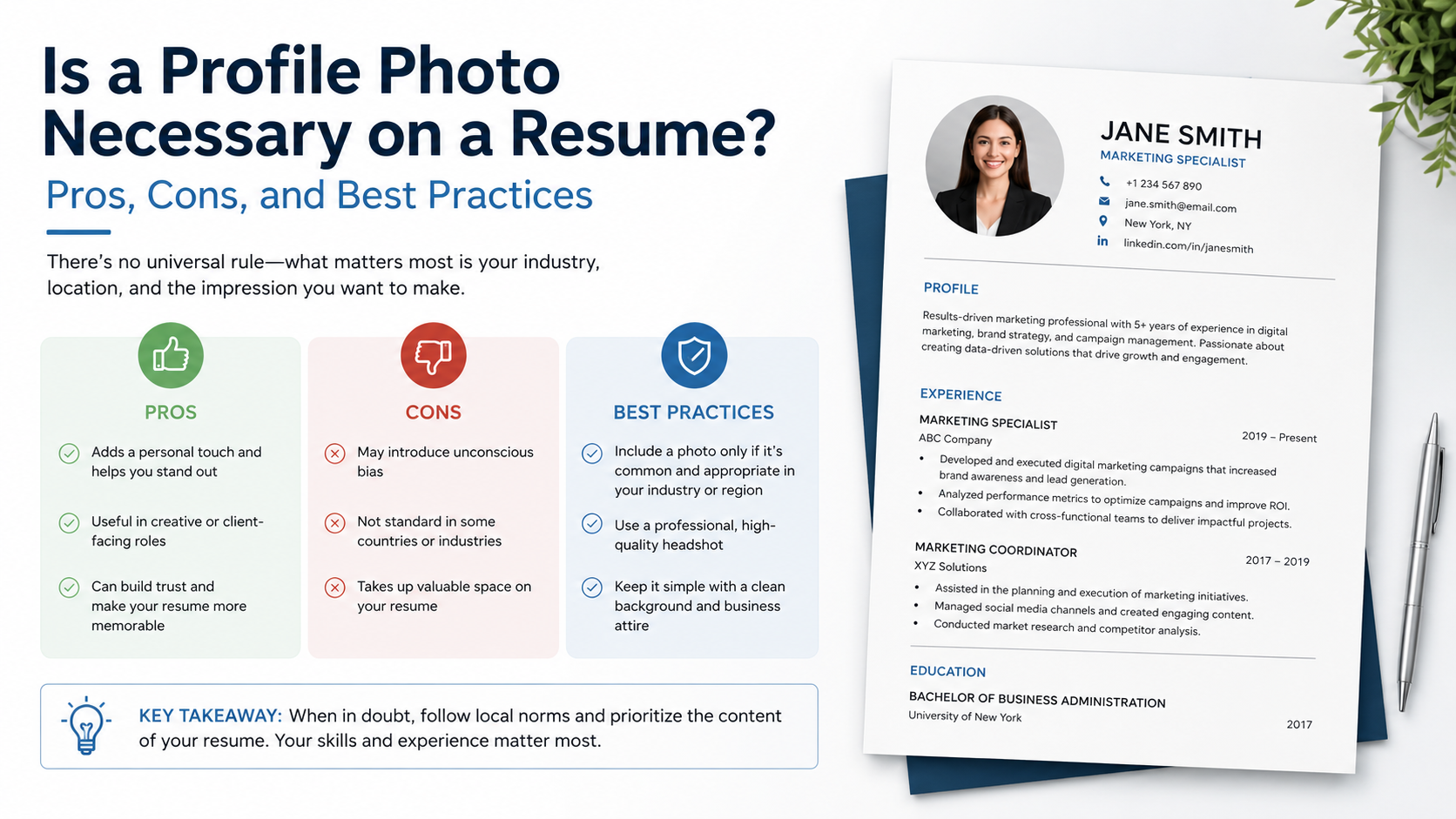
A profile photo on resume documents can seem like a small design choice, but it can influence how employers perceive your professionalism, fit, and attention to detail. More importantly, it may affect whether your application aligns with local hiring norms and anti-discrimination practices.
The right answer is rarely a universal “yes” or “no.” It depends on the country, industry, employer, and role you are pursuing. Understanding the advantages, risks, and practical rules will help you make a thoughtful decision instead of relying on outdated resume advice.
Key Takeaways
- Include a profile photo on resume documents only when it is standard or explicitly requested in the target market.
- Avoid photos in the United States, Canada, and the United Kingdom unless an employer specifically asks for one.
- A professional headshot can support applications in image-focused or client-facing fields, but it should never replace strong experience and skills.
- Research local hiring customs before submitting an international application.
- If you use a photo, choose a current, high-quality headshot with a neutral background and professional appearance.
- When uncertain, leave the photo off your resume and strengthen your LinkedIn profile or portfolio instead.
Why the Profile Photo Question Matters
A resume is designed to show an employer why you can do the job. It should make your qualifications easy to scan, highlight relevant accomplishments, and encourage the reader to contact you.
A photo can add a personal touch, but it also introduces information unrelated to professional ability. Hiring teams may consciously or unconsciously form impressions based on age, ethnicity, gender presentation, disability, or appearance. For that reason, photo expectations vary widely across locations.
Hiring Norms Differ by Country
In many European, Asian, Middle Eastern, and Latin American markets, a profile photo on resume documents is common. In some countries, recruiters may even expect one as part of a standard application.
By contrast, resumes in the United States, Canada, and the United Kingdom generally should not include photos. Employers in these markets often avoid receiving photos because they want to reduce the risk of bias or discrimination claims.
For example:
- A job seeker applying for a hotel management role in Germany may be expected to include a polished headshot.
- A candidate applying for an accounting job in the United States should usually submit a photo-free resume.
- A professional applying to multinational companies should review the job location and local office practices, not just the employer’s headquarters.
Applicant Tracking Systems Also Matter
Many companies use applicant tracking systems (ATS) to scan and organize resumes. While modern systems can process image-based files, a photo may increase file size, complicate formatting, or distract from keyword-rich content.
A clean, text-focused resume is generally more ATS-friendly. If your application will be uploaded through a corporate career portal, prioritize readable headings, standard fonts, and relevant skills over visual elements.
The Benefits of Including a Profile Photo on Resume Documents
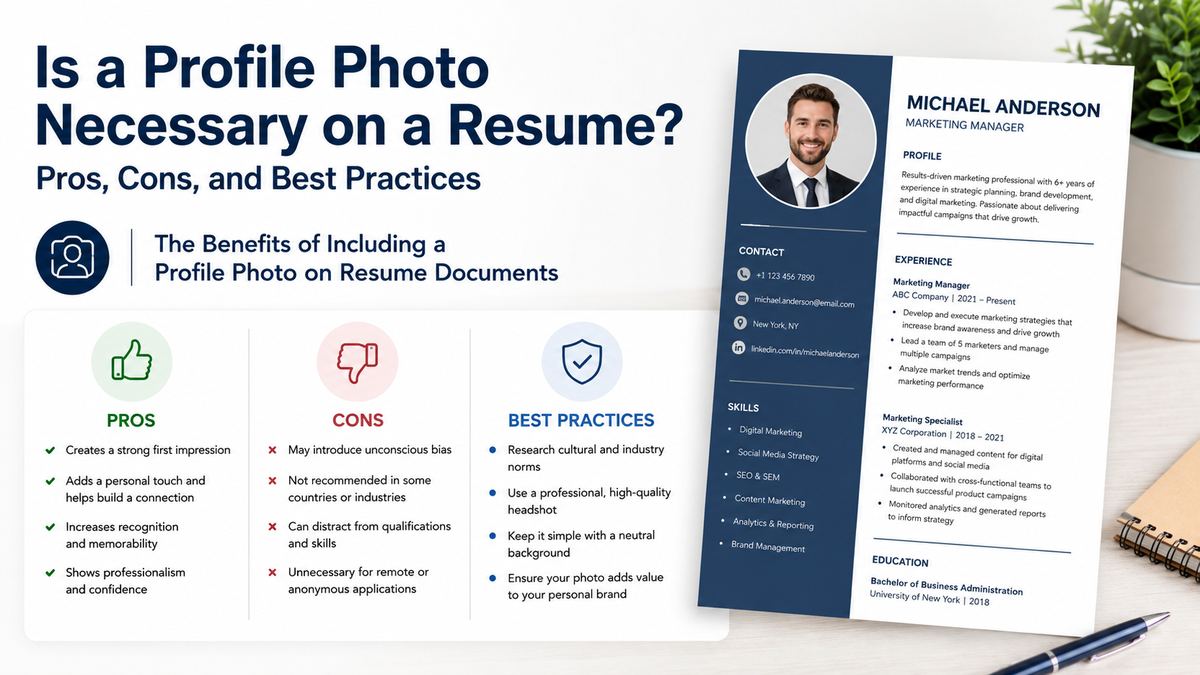
When used in the right context, a professional photo can support your personal brand and make an application feel more complete.
It Can Meet Local Expectations
The clearest reason to include a photo is that it is customary where you are applying. Following established resume conventions demonstrates cultural awareness and helps your application look familiar to recruiters.
For instance, if a hiring manager expects resumes with photos, a well-presented image may make your application feel polished rather than unusual.
It May Support Client-Facing Roles
Some careers rely heavily on public presence, interpersonal rapport, or visual presentation. A photo may be more acceptable for roles such as:
- Hospitality and tourism
- Real estate
- Media and broadcasting
- Modeling and entertainment
- Brand ambassador work
- Public relations
- Luxury retail
- High-end event coordination
Even in these fields, the image should support—not dominate—your qualifications. Employers still need evidence of experience, results, training, and communication skills.
It Helps Build a Consistent Professional Brand
A consistent headshot across your resume, LinkedIn profile, personal website, and portfolio can make your professional identity easier to recognize. This is especially useful for consultants, freelancers, speakers, and creative professionals who market their services directly.
For example, a freelance marketing strategist may use the same headshot on a portfolio website and LinkedIn profile, while keeping the resume itself photo-free for U.S.-based corporate applications.
The Risks and Drawbacks of Adding a Resume Photo
The biggest concern is not whether the photo looks good. It is whether including it could work against your application.
It Can Create Unnecessary Bias
A photo reveals personal characteristics that are not relevant to job performance. Even well-intentioned employers can be influenced by first impressions.
This creates potential disadvantages for applicants based on factors such as:
- Age or perceived age
- Race or ethnicity
- Gender expression
- Religion or cultural dress
- Disability
- Physical appearance
Removing photos helps keep the initial review focused on qualifications. That is why many employers and career advisors in North America recommend leaving them off.
It May Violate Employer Expectations
In some markets, an unexpected profile photo on resume documents can signal that the applicant does not understand local practices. A recruiter may worry that the candidate copied a generic template rather than tailoring the application.
Consider a software engineer applying to a U.S. technology company. Including a headshot may not cause automatic rejection, but it offers little upside and may create avoidable discomfort for the hiring team.
A Poor Photo Can Hurt Your Credibility
A casual selfie, outdated image, distracting background, heavy filters, or low-resolution image can undermine an otherwise strong resume. Even a technically professional photo may feel out of place if it is too large or overwhelms the content.
A resume should never resemble a social-media profile. If your image is not high quality, leaving it off is the better choice.
When You Should Include a Resume Photo
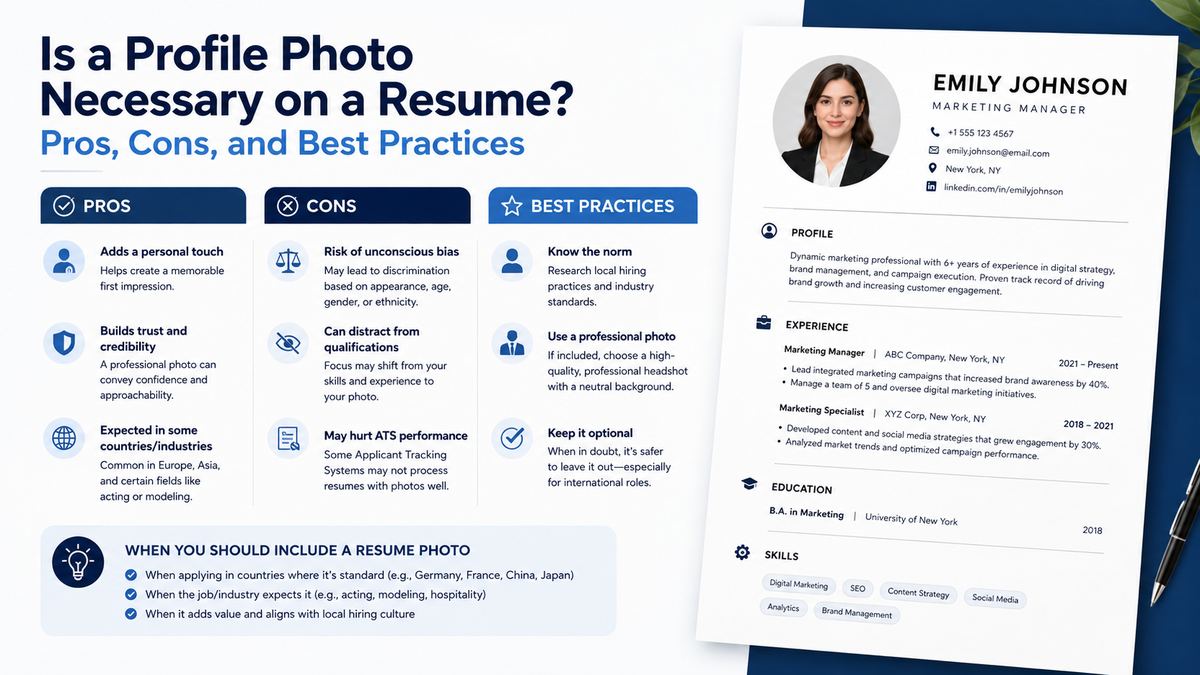
A photo is appropriate only when it serves a clear purpose. Before adding one, review the job posting, research local norms, and consider the employer’s industry.
Include a Photo When It Is Requested
If an employer explicitly asks for a headshot, include one unless doing so conflicts with local law or your comfort level. Follow the requested file format and instructions precisely.
For example, casting calls, event-host roles, and brand-representative positions may request a professional headshot alongside your resume. In these cases, the image is part of the evaluation process.
Include One When It Is Standard in the Target Country
If you are applying in a country where photos are routine, a professional image may be expected. Check reputable local career resources, university career centers, and country-specific resume templates before deciding.
Do not assume all international markets follow the same rule. Hiring customs can differ sharply even between neighboring countries.
Use Caution for Creative or Public-Facing Work
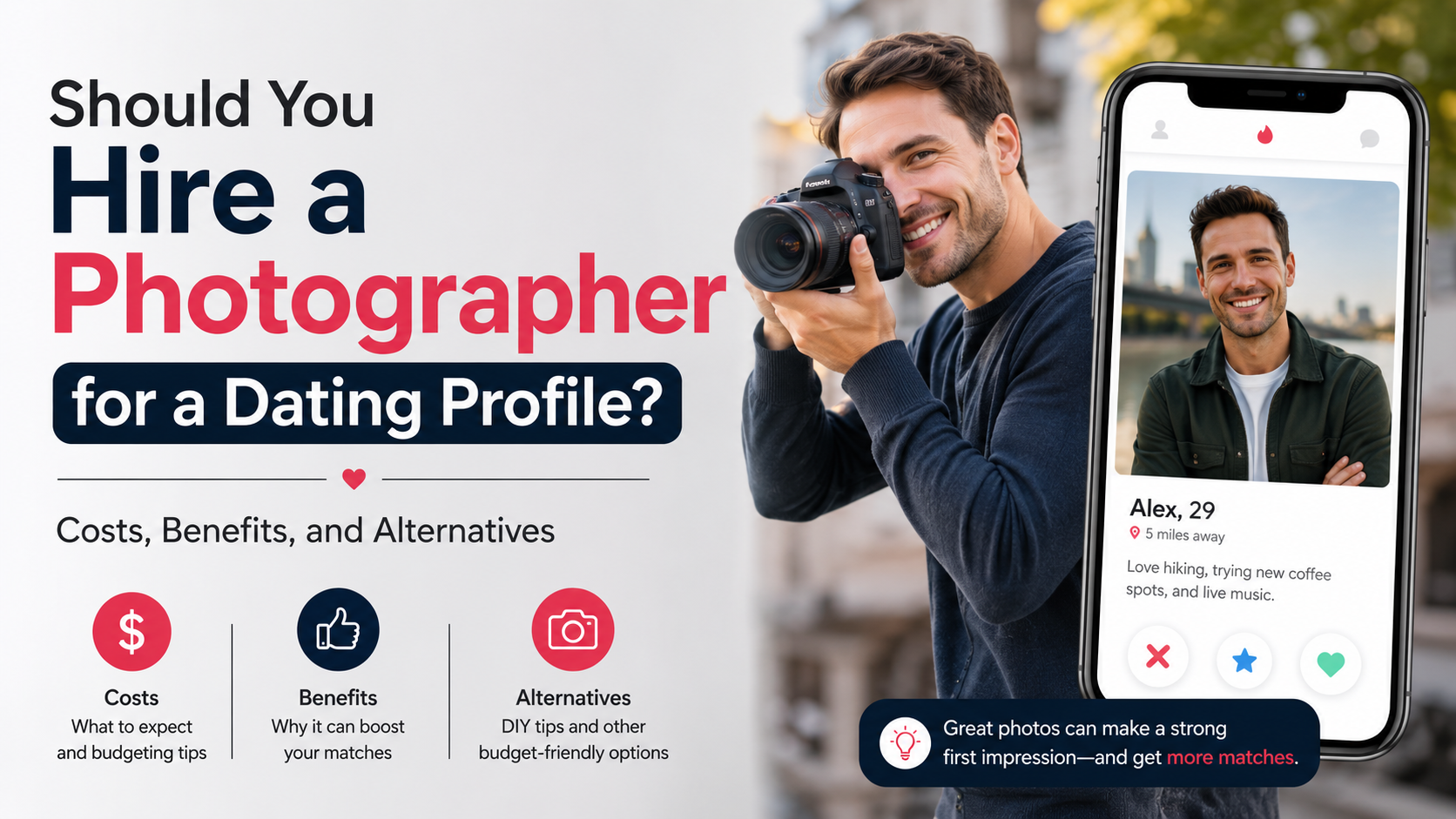
Creative professionals may benefit more from a visual portfolio than a resume photo. A graphic designer, photographer, or actor should make their work easy to access through a portfolio link, website, or dedicated attachment.
A strong rule of thumb: include a photo only if your image is genuinely relevant to the role or expected in that job market.
When You Should Leave the Photo Off
In many cases, excluding a photo is the safest and most strategic choice.
Applying in the United States, Canada, or the United Kingdom
Unless the employer directly requests it, omit your photo from a resume submitted in these markets. Focus instead on a compelling professional summary, measurable achievements, relevant certifications, and a well-structured LinkedIn profile.
This approach aligns with common anti-bias hiring practices and keeps attention on your capabilities.
Applying Through an ATS or Large Corporate Portal
Large organizations often process high volumes of applications using automated systems and standardized recruiter workflows. Visual elements provide little benefit and may create formatting problems.
Use a simple format that includes:
- Your full name and contact details
- A concise professional summary
- Relevant skills and keywords
- Work history with measurable results
- Education, certifications, and portfolio links where appropriate
Applying for Skills-Based or Technical Roles
For roles in engineering, finance, operations, data, law, healthcare, or administration, employers are generally more interested in demonstrated competence than personal presentation.
A data analyst, for example, should prioritize technical tools, dashboard projects, SQL expertise, and business impact—not a headshot.
How to Choose a Professional Resume Photo
If you have determined that a photo belongs on your resume, treat it as part of your professional presentation.
Use a Current, High-Quality Headshot
Choose an image taken within the last one to two years that accurately represents how you appear today. The photo should be sharp, well lit, and cropped from the shoulders or chest upward.
Avoid:
- Vacation photos
- Group photos that have been cropped
- Car selfies or mirror selfies
- Blurry, dark, or filtered images
- Photos with busy backgrounds
- Images that look overly casual or overly stylized
Dress for the Role You Want
Your clothing should match the workplace expectations of your industry. Formal corporate roles may call for business professional attire, while creative or startup environments may allow polished business casual clothing.
The goal is not to look identical to everyone else. It is to look credible, approachable, and appropriate for the position.
Keep the Layout Subtle
Place the image in the upper corner of the resume, usually near your name and contact details. Keep it small enough that your experience remains the visual priority.
A square or circular photo generally works well. Avoid oversized images, decorative frames, or graphics that consume valuable space.
Better Alternatives to a Resume Photo
If you want to create a more memorable application without including a profile photo on resume documents, there are stronger options.
Add a Professional LinkedIn URL
A customized LinkedIn URL lets recruiters view your profile, recommendations, work history, and photo voluntarily. This provides more context without placing appearance at the center of your resume.
Make sure your LinkedIn profile is current, consistent with your resume, and free of outdated information.
Link to a Portfolio or Personal Website
A portfolio is especially valuable for writers, designers, developers, marketers, consultants, and other professionals whose work can be demonstrated visually or interactively.
Your portfolio should include relevant examples, brief project explanations, and results when available. For example, a content marketer could link to case studies showing organic traffic growth, conversion improvements, and campaign outcomes.
Strengthen Your Professional Summary
A compelling summary can create a stronger first impression than a photo. In two or three lines, identify your role, strongest skills, and most relevant value.
For example:
Operations coordinator with five years of experience improving scheduling, vendor communication, and process efficiency across fast-paced logistics teams.
That statement immediately tells the employer what you do and how you can help.
Frequently Asked Questions
Should I put a profile photo on my resume?
Include a photo only when it is requested, customary in the target country, or clearly relevant to the role. For most applications in the United States, Canada, and the United Kingdom, leave it off.
Is a LinkedIn photo different from a resume photo?
Yes. LinkedIn is a professional networking platform where a profile photo is normal and often beneficial. A resume is a formal hiring document, and photo expectations depend more heavily on local hiring norms and anti-bias practices.
Can a resume photo improve my chances of getting hired?
A professional photo may help an application look complete in markets where photos are expected. However, it does not compensate for weak qualifications, unclear achievements, or poor tailoring. In the wrong market, it can create unnecessary risk instead.
What kind of photo should I use on a resume?
Use a recent, professional headshot with good lighting, a simple background, appropriate attire, and a natural expression. Keep the image small and avoid casual or heavily edited photos.
Should I include a photo for international job applications?
Research the hiring expectations of the specific country where the role is based. If you are applying to several countries, create separate resume versions rather than using one universal format.
Conclusion
A profile photo on resume documents is not inherently good or bad—it is a strategic decision shaped by location, industry, and employer expectations. In photo-friendly markets, a polished headshot can reinforce professionalism. In the United States, Canada, and the United Kingdom, it is usually wiser to leave it off and keep the focus on your experience.
Before submitting your next application, research the target market, review the job posting, and tailor your resume accordingly. When in doubt, let your skills, achievements, portfolio, and professional summary make the strongest first impression.